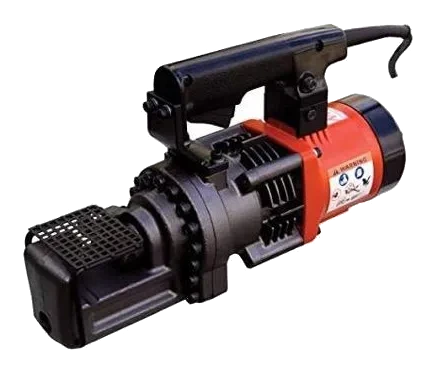
A rebar bender bends reinforcing steel around a former to a set angle, so every bar in a batch comes out identical.
Stirrups and ties, hooks and 90° bends, column and beam cages, and any job with the same bend repeated many times over.
Set the angle stop before bending and test on an offcut. Steel springs back a little when it is released, so the stop usually has to sit slightly past the angle actually wanted.
That spring-back is the whole skill. One test bar at the start saves re-bending a day's worth at the end.
Catalogue specifications
Weight: 331 lb
Unit Specifications
Max. Rebar Diameter 1 in 25.4 mm
Bending Range 0 to 180
Max. Bending Speed 180° - Approx. 5 sec
Electric Motor 115V, 60 Hz, 1 , AC
Bending Radius Specifications
No. 3 Rebar Diameter 3/8 in 9.5 mm Radius 2.25 in 57 mm
No. 4 Rebar Diameter 1/2 in 12.7 mm Radius 3 in 76 mm
No. 5 Rebar Diameter 5/8 in 15.9 mm Radius 3.75 in 95 mm
No. 6 Rebar Diameter 3/4 in 19 mm Radius 4.5 in 114 mm
No. 7 Rebar Diameter 7/8 in 22.2 mm Radius 5.25 in 133 mm
No. 8 Rebar Diameter 1 in 25.4 mm Radius 6 in 152.4 mm
Dimensions & Weights
Overall Length 21 in 530 mm
Overall Width 19.5 in 500 mm
Overall Height 17 in 430 mm
Operating Weight 227 lb 103 kg
What this will run
Typical figures for this class of machine. Check the data plate before promising a customer.
Best uses
Stirrups and ties
Hooks and 90° bends
Column and beam cages
Repeated bends to a set angle
Troubleshooting
Bends come out at the wrong angle
Checks to try, in order
Re-set the angle stop.
Allow for spring-back — bend slightly past the target angle.
Reference draft — always follow the manufacturer’s manual.
Always follow the manufacturer’s manual and site safety rules. Favourites and viewing history are stored on this device.
FRAUD ALERT
We are aware of an individual claiming to be the CEO of Hilton Machineries & Sales Company and falsely representing that they are purchasing equipment through Massive Equipment & Sales Ltd.
Massive Equipment has no affiliation with this company or individual. Do not send funds, deposits or financial information in connection with these communications.
To verify any request, contact us directly at 345-949-7990 or info@massivegroup.com.