18 · Saws

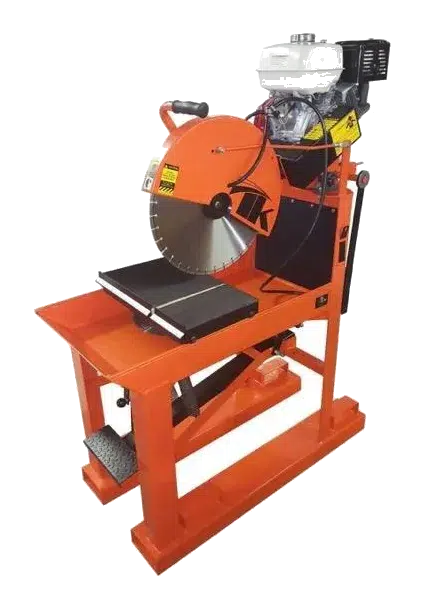
Pavement Saw

Also called Concrete saw · Road saw · Floor saw · Walk-behind saw · Asphalt cutter

A walk-behind diamond saw for straight, deep cuts in asphalt and concrete roads, floors and slabs.

Petrol engine

Overview

A pavement saw is a walk-behind diamond saw that cuts a straight, deep line through asphalt or concrete. Cutting the edge first is what stops a repair tearing ragged when the slab is broken out.

We rent an 18 in and a 20 in, the larger one self-propelled so it walks itself through the cut instead of being pushed.

Cutting out asphalt and concrete for repairs, trenches for utilities, control and expansion joints, and scoring a slab before breaking it.

Match the blade to the material. An asphalt blade on concrete, or a concrete blade on asphalt, wears out quickly and cuts badly the whole time it is doing so.

Snap a chalk line and follow it with the saw's pointer, lower the blade gradually, and take a deep slab in several passes rather than one.

Best uses

  • Cutting out asphalt and concrete for repairs
  • Trenches for utilities
  • Control and expansion joints
  • Straight cuts before breaking out a slab

Not suited for

  • Using an asphalt blade on concrete, or a concrete blade on asphalt — they wear out quickly

Troubleshooting

Saw wanders off the line

Checks to try, in order

  1. Line the pointer up with the blade.
  2. Push straight — don't steer by twisting the handles.

Reference draft — always follow the manufacturer’s manual.

Link to this fixDid this solve the problem?
No water reaching the blade

Checks to try, in order

  1. Fill the water tank or connect the supply.
  2. Open the water valve.
  3. Clear a blocked spray line.

Reference draft — always follow the manufacturer’s manual.

Link to this fixDid this solve the problem?
Blade overheating or losing segments

Checks to try, in order

  1. Stop immediately.
  2. Make sure water is flowing.
  3. Check the blade is rated for the material being cut.

Reference draft — always follow the manufacturer’s manual.

Link to this fixDid this solve the problem?
Engine won't startShared · Petrol engine

Likely causes

  • Fuel valve or switch off
  • Stale fuel
  • Low oil sensor
  • Choke position
  • Spark plug cap loose

Checks to try, in order

  1. Turn the fuel valve ON and the engine switch to ON.
  2. Cold engine: close the choke. Warm engine: leave the choke open.
  3. Check there is fresh petrol in the tank — stale or water-contaminated fuel is the most common cause.
  4. Check the engine oil. Many engines have a low-oil shutdown that stops them starting when oil is low or the machine is on a slope — top up and set the machine on level ground.
  5. Make sure the spark plug cap is pushed fully onto the plug.
  6. Pull the starter rope with a smooth, firm pull — don't let it snap back.

If the starter rope is locked or unusually hard to pull, stop — don't force it. Tag the unit and return it to the workshop.

Reference draft — always follow the manufacturer’s manual.

Link to this fixDid this solve the problem?
Starts, then stalls or runs roughShared · Petrol engine

Likely causes

  • Choke left on
  • Blocked air filter
  • Low fuel
  • Low-oil shutdown

Checks to try, in order

  1. Open the choke gradually once the engine has warmed up.
  2. Check the fuel level and that the fuel cap vent isn't blocked.
  3. Check the air filter — a dusty filter chokes the engine. Tap it out or swap it.
  4. Check the oil level again; the low-oil sensor can cut the engine on uneven ground.

Reference draft — always follow the manufacturer’s manual.

Link to this fixDid this solve the problem?
Smell of fuel or a visible leakShared · Petrol engine

Checks to try, in order

  1. Switch the engine off immediately and move away any ignition sources.
  2. Turn the fuel valve OFF.
  3. Check the fuel cap is seated and look for a wet fuel line or carburettor bowl.

Don't run a machine that is leaking fuel. Tag it out and report it.

Reference draft — always follow the manufacturer’s manual.

Link to this fixDid this solve the problem?

Safety

  • Locate buried utilities before cutting.
  • Wear hearing protection and a respirator.
  • Run outdoors only — petrol exhaust.

For petrol engine

  • Refuel only with the engine off and cool. No smoking or open flames nearby.
  • Exhaust contains carbon monoxide — never run it indoors, in trenches or in enclosed spaces without ventilation.
  • Wear hearing protection, safety glasses and safety boots.

Videos & links

Related equipment

All Saws →

Always follow the manufacturer’s manual and site safety rules. Favourites and viewing history are stored on this device.