09 · Heavy Equipment

Trencher

Also called Walk-behind trencher · Ditch witch · Chain trencher

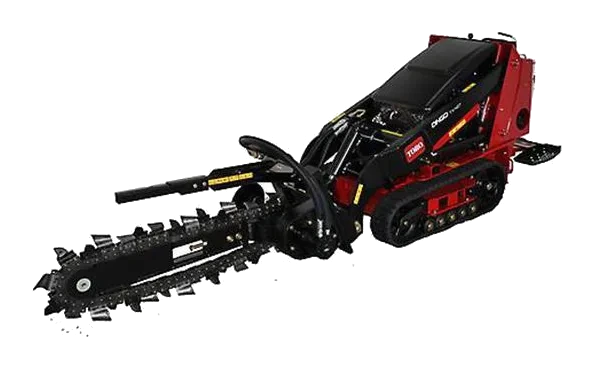
A toothed chain that cuts a narrow, even trench for cable, pipe and irrigation far faster than digging by hand.

Petrol engine

Overview

A trencher cuts a narrow slot in the ground with a toothed chain running round a boom, throwing the spoil to one side as it goes.

It is the right machine whenever the trench is long, narrow and shallow — irrigation, electrical conduit, water lines and drainage.

A trench cut this way has clean, straight walls, so it needs far less backfill and compaction than one dug with a bucket.

Ground conditions decide everything. Trenchers do well in soil and soft ground; rock, rubble and tree roots stop them.

Catalogue specifications

  • Max Trench Depth 18 In.
  • Max Trench Width 3 In.
  • Max Chain Speed 180 Ft. Per Minute
  • Displacement 196cc
  • Dry Weight 250 Lbs
  • Engine HONDA Gx200

Best uses

  • Irrigation and sprinkler lines
  • Electrical conduit runs
  • Water and drainage pipe
  • Long, straight, shallow trenches

Not suited for

  • Rocky ground, rubble fill or heavy tree roots
  • Short trenches where setting up takes longer than digging
  • Anywhere services are buried and unmarked

Troubleshooting

The chain turns but does not dig in

Checks to try, in order

  1. Lower the boom more slowly and let the teeth bite.
  2. Check the teeth are not worn round — blunt teeth polish the ground instead of cutting.
  3. Hard, dry ground cuts much better after a soaking.

Reference draft — always follow the manufacturer’s manual.

Link to this fixDid this solve the problem?
The engine bogs down or stalls in the cut

Checks to try, in order

  1. Ease back on the travel speed — the chain is taking too big a bite.
  2. Raise the boom, clear the trench, and start again shallower.
  3. If it keeps stalling on rock or roots, this is the wrong machine for the ground.

Reference draft — always follow the manufacturer’s manual.

Link to this fixDid this solve the problem?
The chain is loose or jumps the boom

Checks to try, in order

  1. Stop the engine before touching the chain.
  2. A chain that has stretched needs tensioning — check the manual's slack figure.

Reference draft — always follow the manufacturer’s manual.

Link to this fixDid this solve the problem?
Engine won't startShared · Petrol engine

Likely causes

  • Fuel valve or switch off
  • Stale fuel
  • Low oil sensor
  • Choke position
  • Spark plug cap loose

Checks to try, in order

  1. Turn the fuel valve ON and the engine switch to ON.
  2. Cold engine: close the choke. Warm engine: leave the choke open.
  3. Check there is fresh petrol in the tank — stale or water-contaminated fuel is the most common cause.
  4. Check the engine oil. Many engines have a low-oil shutdown that stops them starting when oil is low or the machine is on a slope — top up and set the machine on level ground.
  5. Make sure the spark plug cap is pushed fully onto the plug.
  6. Pull the starter rope with a smooth, firm pull — don't let it snap back.

If the starter rope is locked or unusually hard to pull, stop — don't force it. Tag the unit and return it to the workshop.

Reference draft — always follow the manufacturer’s manual.

Link to this fixDid this solve the problem?
Starts, then stalls or runs roughShared · Petrol engine

Likely causes

  • Choke left on
  • Blocked air filter
  • Low fuel
  • Low-oil shutdown

Checks to try, in order

  1. Open the choke gradually once the engine has warmed up.
  2. Check the fuel level and that the fuel cap vent isn't blocked.
  3. Check the air filter — a dusty filter chokes the engine. Tap it out or swap it.
  4. Check the oil level again; the low-oil sensor can cut the engine on uneven ground.

Reference draft — always follow the manufacturer’s manual.

Link to this fixDid this solve the problem?
Smell of fuel or a visible leakShared · Petrol engine

Checks to try, in order

  1. Switch the engine off immediately and move away any ignition sources.
  2. Turn the fuel valve OFF.
  3. Check the fuel cap is seated and look for a wet fuel line or carburettor bowl.

Don't run a machine that is leaking fuel. Tag it out and report it.

Reference draft — always follow the manufacturer’s manual.

Link to this fixDid this solve the problem?

Safety

  • Confirm what is buried before cutting. A trencher goes through a live cable or water main without slowing down.
  • Keep both hands on the controls and bystanders well clear of the spoil side.
  • Never clear the chain with the engine running.

For petrol engine

  • Refuel only with the engine off and cool. No smoking or open flames nearby.
  • Exhaust contains carbon monoxide — never run it indoors, in trenches or in enclosed spaces without ventilation.
  • Wear hearing protection, safety glasses and safety boots.

Videos & links

Related equipment

All Heavy Equipment →

Always follow the manufacturer’s manual and site safety rules. Favourites and viewing history are stored on this device.