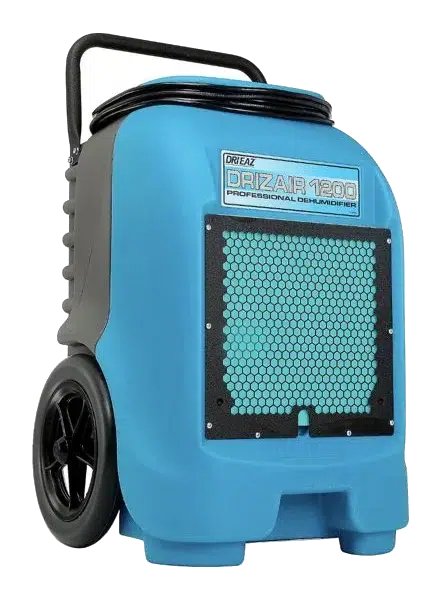
13 · Floor Care

Hybrid Air Dryer

Also called Air mover · Carpet dryer · Hybrid dryer · Drizair dryer

A directional dryer that pushes air across floors, carpets and walls to speed drying after a flood or a wash.

Electric (corded)

Overview

A hybrid air dryer moves a focused stream of air across a surface. Moving air carries moisture away far faster than still air, which is what dries a carpet or a wall.

It is used after water damage, after carpet extraction, and to speed up drying of paint, screed and sealed floors.

Hybrid units can be angled: flat along a floor, up a wall, or stacked to dry a room from several directions at once.

For serious water damage, pair them with the dehumidifier. The dryers move the moisture out of the material, the dehumidifier takes it out of the air.

Catalogue specifications

  • This dryer has an incredible maximum air velocity of 3,400 feet per minute in a compact, yet highly efficient size. Carpets dry quickly under the high-volume, high-velocity airflow.
  • MODEL PDH1
  • RUNNING AMPS 2.8
  • POWER 120V
  • MOTOR .4 HP .
  • SPEEDS 3
  • AIR VELOCITY 3,400 FPM
  • HOUSING co-polymer polypropylene
  • STACKABLE Yes
  • POWER CORD 20 . / 6 m
  • NET WEIGHT 17.75 lbs. / 8 kg
  • DRYING POSITIONS 2 (0° and 90°)
  • DIMENSIONS 22" x 16.5" x 11.5"

Best uses

  • Drying carpet after extraction
  • Water damage restoration
  • Speeding up drying of walls and floors
  • Airing out closed rooms

Not suited for

  • Rooms with heavy dust or mould without containment — it spreads spores

Troubleshooting

Drying is taking far too long

Checks to try, in order

  1. Add a dehumidifier — moving wet air around a closed room dries nothing.
  2. Add more units and angle them along the surface rather than at it.
  3. Lift carpet edges where possible so air reaches the underlay.

Reference draft — always follow the manufacturer’s manual.

Link to this fixDid this solve the problem?
Trips the breaker when several are running

Checks to try, in order

  1. Spread the units across different circuits.
  2. Check the total draw against the circuit rating before plugging more in.

Reference draft — always follow the manufacturer’s manual.

Link to this fixDid this solve the problem?
Tool won't switch onShared · Electric (corded)

Likely causes

  • Tripped GFCI or breaker
  • Lock-off button
  • Damaged cord
  • Dead outlet

Checks to try, in order

  1. Check the outlet works and reset any GFCI / RCD that has tripped.
  2. Release the lock-off button or safety switch before squeezing the trigger.
  3. Inspect the cord and extension lead for cuts, crushed sections or damaged plugs.
  4. If running from a generator, make sure it's running and its breaker hasn't tripped.

A damaged cord or plug means the tool is out of service. Tag it and return it — never tape a cord.

Reference draft — always follow the manufacturer’s manual.

Link to this fixDid this solve the problem?
Keeps tripping the breakerShared · Electric (corded)

Likely causes

  • Circuit overloaded
  • Undersized extension cord
  • Blunt accessory

Checks to try, in order

  1. Plug into a circuit with nothing else heavy running on it.
  2. Use a shorter, heavier extension cord. Long, thin cords starve the motor and trip breakers.
  3. Don't force the tool — a dull bit, blade or disc makes the motor draw more current.

Reference draft — always follow the manufacturer’s manual.

Link to this fixDid this solve the problem?
Overheating, burning smell or heavy sparkingShared · Electric (corded)

Checks to try, in order

  1. Stop and unplug the tool.
  2. Check the motor vents aren't blocked with dust.
  3. Let it cool, fit a sharp accessory and let the tool's weight do the work.

Heavy sparking from the vents or a burning smell that returns points to worn brushes or a failing motor — workshop only.

Reference draft — always follow the manufacturer’s manual.

Link to this fixDid this solve the problem?

Safety

  • Keep cords out of standing water, and use an RCD-protected supply in wet conditions.
  • Do not run them in a room with suspected mould until it is contained.

For electric (corded)

  • Inspect the cord and plug before every use. Use a GFCI/RCD outdoors or near water.
  • Unplug before changing blades, bits, discs or pads.
  • Wear eye protection, and a dust mask when cutting, grinding or sanding masonry.

Videos & links

Related equipment

All Floor Care →

Always follow the manufacturer’s manual and site safety rules. Favourites and viewing history are stored on this device.