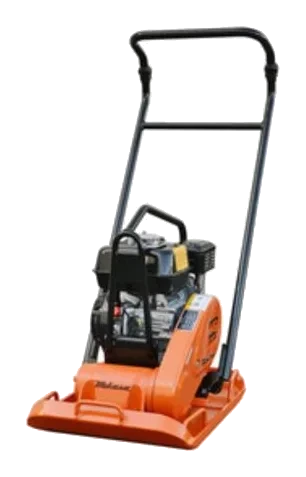
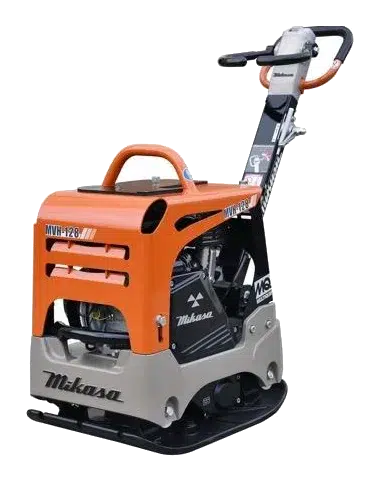
A rammer, or jumping jack, compacts by pounding. A spring-loaded foot hammers straight down, driving force deeper than a vibrating plate reaches and squeezing the air out of cohesive soil.
That makes it the clay machine: trench backfill around pipes and cables, footings, post holes and tight spots where compaction has to go deep and the space is narrow.
We rent two sizes — the Ele (“Elephant”), the larger, and the Kanga (“Kangaroo”), the smaller. Sand and gravel are the wrong material for either; granular work belongs to a plate.
Guide it, do not push down on it. The machine's own weight and stroke do the work, with a slight forward tilt in the direction of travel.
Catalogue specifications · Kanga
Lightweight and portable - only 101 pounds (46 kg)
Convenient handle allows rammer to be lifted by one person
Designed specifically for narrow trench work - grease lubricated design for long life
Ideal for landscapers, electrical contractors and plumbing contractors
Optional foot extensions available for trench work
SPECS.
MODEL MTR-40F U.S. (metric)
Overall Height 43.7 in. (1,110 mm)
Overall Width 13.8 in. (351 mm)
Overall Length 24.5 in. (622 mm)
Shoe Size 5.9 x 10.6 in. (150 x 270 mm)
Blows/minute 650 ~ 699
Tamping Area 1,453 sq. ft. per hr (135 sq.m per hr)
Impact Force 1,215 lbs./blow ( 550 kg/blow)
Clutch Automatic Centrifugal
Travel Speed 30 fpm (9 mpm)
Stroke (Jump Height) 2.2 in. (55 mm)
Operating Weight 101 lbs. (46 kg
What this will run
Typical figures for this class of machine. Check the data plate before promising a customer.
Best uses
Clay and cohesive soils
Trench backfill around pipes and cables
Footings, post holes and tight spots
Deeper compaction than a plate
Not suited for
Sand and gravel — use a plate compactor
Large open areas
Troubleshooting
Leaking fuel or oil after transport, or hard to start
Likely causes
Transported lying down
Fuel valve left on
Checks to try, in order
Rammers must travel upright. Laid on its side, the engine floods and leaks fuel and oil.
Stand it upright, wipe up spills and wait 10–15 minutes before starting.
Pull with the choke open if it smells strongly of fuel.
Reference draft — always follow the manufacturer’s manual.
Turn the fuel valve ON and the engine switch to ON.
Cold engine: close the choke. Warm engine: leave the choke open.
Check there is fresh petrol in the tank — stale or water-contaminated fuel is the most common cause.
Check the engine oil. Many engines have a low-oil shutdown that stops them starting when oil is low or the machine is on a slope — top up and set the machine on level ground.
Make sure the spark plug cap is pushed fully onto the plug.
Pull the starter rope with a smooth, firm pull — don't let it snap back.
If the starter rope is locked or unusually hard to pull, stop — don't force it. Tag the unit and return it to the workshop.
Reference draft — always follow the manufacturer’s manual.
Always follow the manufacturer’s manual and site safety rules. Favourites and viewing history are stored on this device.
FRAUD ALERT
We are aware of an individual claiming to be the CEO of Hilton Machineries & Sales Company and falsely representing that they are purchasing equipment through Massive Equipment & Sales Ltd.
Massive Equipment has no affiliation with this company or individual. Do not send funds, deposits or financial information in connection with these communications.
To verify any request, contact us directly at 345-949-7990 or info@massivegroup.com.