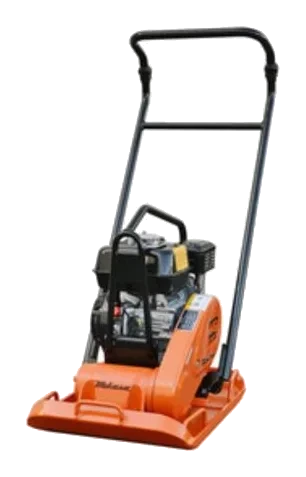
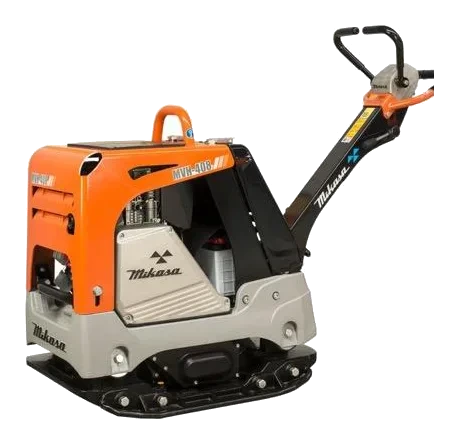
The large plate works the same way as the small one — a vibrating steel base plate driving granular material into a dense layer — but with more weight behind it, so it covers more ground per pass and compacts a deeper lift.
Use it on driveway and parking-lot sub-base, large patios, slab preparation and road shoulders: anywhere open enough to run long straight passes.
It gives up the small plate's manoeuvrability. Narrow trenches and tight corners are not its job, and like every plate it will not compact cohesive clay.
Pick by area and depth. Small plate for tight spaces and shallow lifts, large plate for open areas and deeper ones. On slopes, work straight up and down, never across.
Catalogue specifications
Weight: 225 lb
Unit Specifications
Centrifugal Force 3372 lbf 15 kN
Exciter Speed 6000 VPM
Plate Size 19.7 x 20.7 in
500 x 525 mm
Max Forward Speed
Per Min. 82 ft 25 m
Fuel Consumption
Per Hour 0.31 gal 1.17 L
Dimensions & Weights
Overall Length 41.75 in 1060 mm
Overall Width 19.75 in 502 mm
Overall Height 37 in 940 mm
Shipping Dimensions 38 x 22 x 29 in
965 x 559 x 737 mm
Operating Weight 207 lb 94 kg
What this will run
Typical figures for this class of machine. Check the data plate before promising a customer.
Best uses
Driveway and parking-lot sub-base
Large patios and slab preparation
Deeper lifts of granular material
Road shoulders and open areas
Not suited for
Narrow trenches and tight corners
Cohesive clay soils
Troubleshooting
Hard to steer or drifts to one side
Checks to try, in order
Plates track straight on level, even material. Drift usually means the surface is uneven or sloped.
Guide the handle gently. Don't wrestle it.
Clean built-up material off the underside of the plate.
Reference draft — always follow the manufacturer’s manual.
Turn the fuel valve ON and the engine switch to ON.
Cold engine: close the choke. Warm engine: leave the choke open.
Check there is fresh petrol in the tank — stale or water-contaminated fuel is the most common cause.
Check the engine oil. Many engines have a low-oil shutdown that stops them starting when oil is low or the machine is on a slope — top up and set the machine on level ground.
Make sure the spark plug cap is pushed fully onto the plug.
Pull the starter rope with a smooth, firm pull — don't let it snap back.
If the starter rope is locked or unusually hard to pull, stop — don't force it. Tag the unit and return it to the workshop.
Reference draft — always follow the manufacturer’s manual.
Always follow the manufacturer’s manual and site safety rules. Favourites and viewing history are stored on this device.
FRAUD ALERT
We are aware of an individual claiming to be the CEO of Hilton Machineries & Sales Company and falsely representing that they are purchasing equipment through Massive Equipment & Sales Ltd.
Massive Equipment has no affiliation with this company or individual. Do not send funds, deposits or financial information in connection with these communications.
To verify any request, contact us directly at 345-949-7990 or info@massivegroup.com.