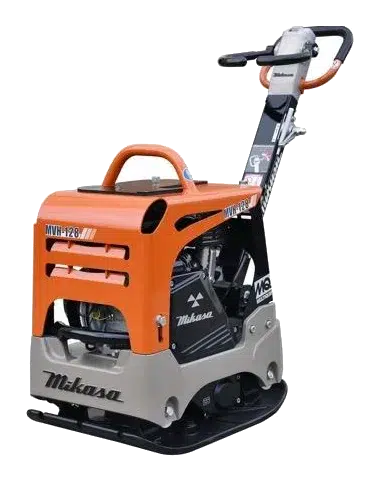
The large reversible is the heaviest plate we rent: a Honda GX390 petrol engine driving a reversing plate with enough force to stand in for a roller where a roller cannot fit.
It is the machine for deep granular fill and backfill, building pads and foundations, and for the edges and corners a roller has to leave behind. On a big job it often works alongside a roller rather than instead of it.
Clay and saturated soils are outside what any plate will do.
It is genuinely heavy. Load it with a hoist through the lifting point or up a proper ramp, never by the handle. The GX390 has a low-oil shutdown, so check the oil with the machine sitting level.
Catalogue specifications · Honda GX390
MOD MVH306DS
CENTRIFUGAL FORCE LBS(KN) 10,125(4,592)
EXCITER SPEED 3,600VPM
SPEED MIN FT(M) 75(23)
ENGINE HONDA HP(KW) 7.0(5.3)
PLATE SIZE IN(MM) 24x34 (61x86)
WEIGHT LBS(KG) 725(328)
MOD MVH306GH
ENGINE HONDA HP(KW) 9.0(6.7)
WEIGHT LBS(KG) 706(320)
What this will run
Typical figures for this class of machine. Check the data plate before promising a customer.
Best uses
Deep granular fill and backfill
Building pads and foundations
Confined areas where a roller won't fit
Supporting a roller on edges and corners
Not suited for
Clay and saturated soils
Troubleshooting
Engine cuts out on uneven ground
Checks to try, in order
The GX390 has a low-oil shutdown. Check the oil with the machine sitting level.
Top up to the full mark if needed, then restart on flat ground.
Reference draft — always follow the manufacturer’s manual.
Turn the fuel valve ON and the engine switch to ON.
Cold engine: close the choke. Warm engine: leave the choke open.
Check there is fresh petrol in the tank — stale or water-contaminated fuel is the most common cause.
Check the engine oil. Many engines have a low-oil shutdown that stops them starting when oil is low or the machine is on a slope — top up and set the machine on level ground.
Make sure the spark plug cap is pushed fully onto the plug.
Pull the starter rope with a smooth, firm pull — don't let it snap back.
If the starter rope is locked or unusually hard to pull, stop — don't force it. Tag the unit and return it to the workshop.
Reference draft — always follow the manufacturer’s manual.
Always follow the manufacturer’s manual and site safety rules. Favourites and viewing history are stored on this device.
FRAUD ALERT
We are aware of an individual claiming to be the CEO of Hilton Machineries & Sales Company and falsely representing that they are purchasing equipment through Massive Equipment & Sales Ltd.
Massive Equipment has no affiliation with this company or individual. Do not send funds, deposits or financial information in connection with these communications.
To verify any request, contact us directly at 345-949-7990 or info@massivegroup.com.