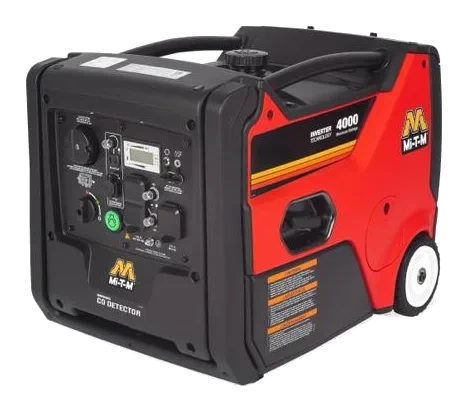
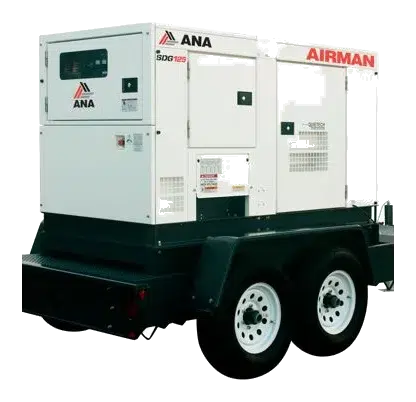
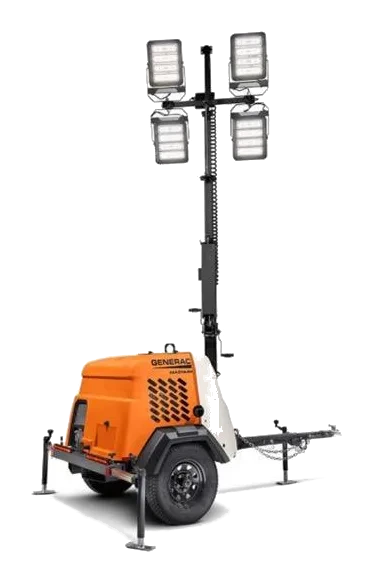
In a power outage a generator makes a great backup power source. Generators convert mechanical energy into electrical energy and can run essential appliances and electronics.
First, choose the right size — it depends on the wattage of the appliances and electronics you want to run.
Conventional generators run at a constant engine speed, and that higher engine speed gives consistent power.
They cost less than inverter generators, so they can be more affordable — but remember to budget for fuel.
Catalogue specifications · 14 kW
Weight: 342 lb
Alternator Design Brushless
Frequency 60 hz
Phase Single Phase
Voltage 120/240 V
Sound level at 30 ft 79 dBA
Fuel Tank Capacity 10 gal 37.8 L
Power Generation
Maximum Continuous
Watts 9700 W 8400 W
Amps at 120V 80.8 A 70 A
Amps at 240V 40.4 A 35 A
Receptacles & Circuit Breakers
Main Circuit Breaker 40 A
Number of Poles 2
1 Receptacle of Each: 5-20R 125V GFCI 20A
L5-20R 125V T-Lock 20A
L5-30R 125V T-Lock 30A
L14-30R 125/250V T-Lock 30A
Dimensions & Weights
Overall Length 31.25 in 800 mm
Overall Width 21.25 in 540 mm
Overall Height 27.5 in 700 mm
What this will run
Typical figures for this class of machine. Check the data plate before promising a customer.
Best uses
Job-site power for saws, compressors and lights
Backup power during outages
Higher-wattage loads on a budget
Pumps and heavy motor loads
Not suited for
Sensitive electronics and medical equipment — use an inverter generator
Troubleshooting
Engine runs but nothing gets power
Likely causes
Main breaker off
GFCI tripped
Faulty extension cord
Checks to try, in order
Switch the generator's main breaker ON.
Press reset on the GFCI outlets on the generator panel.
Unplug everything, then reconnect loads one at a time, starting with the biggest.
Check the extension cord works on another outlet.
Reference draft — always follow the manufacturer’s manual.
Turn the fuel valve ON and the engine switch to ON.
Cold engine: close the choke. Warm engine: leave the choke open.
Check there is fresh petrol in the tank — stale or water-contaminated fuel is the most common cause.
Check the engine oil. Many engines have a low-oil shutdown that stops them starting when oil is low or the machine is on a slope — top up and set the machine on level ground.
Make sure the spark plug cap is pushed fully onto the plug.
Pull the starter rope with a smooth, firm pull — don't let it snap back.
If the starter rope is locked or unusually hard to pull, stop — don't force it. Tag the unit and return it to the workshop.
Reference draft — always follow the manufacturer’s manual.
Always follow the manufacturer’s manual and site safety rules. Favourites and viewing history are stored on this device.
FRAUD ALERT
We are aware of an individual claiming to be the CEO of Hilton Machineries & Sales Company and falsely representing that they are purchasing equipment through Massive Equipment & Sales Ltd.
Massive Equipment has no affiliation with this company or individual. Do not send funds, deposits or financial information in connection with these communications.
To verify any request, contact us directly at 345-949-7990 or info@massivegroup.com.