08 · Generators & Welders

Welder

Also called Welding machine · Welder generator · Stick welder · Arc welder

Engine-driven welders that strike an arc anywhere on site and double as a generator for tools and lights.

Diesel machine

Selected model

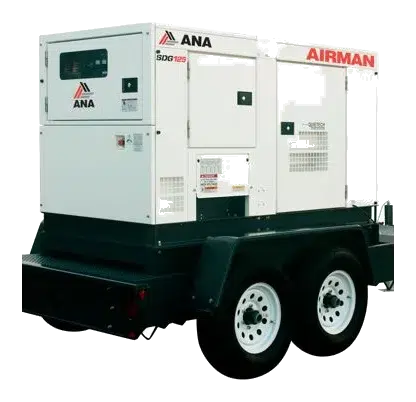
Welder · 300A trailer

Heavy and continuous work

Overview

A welder joins metal by melting the edges together with an electric arc, adding filler from a rod or wire as it goes.

Ours are engine-driven, so they need no mains power. That also makes them a generator: the 180A unit gives 3.5 kW of auxiliary power, the 225A gives 6 kW, enough to run grinders and lights off the same machine.

Rebar cages, gates, railings, brackets, trailer repairs and structural steel are the usual jobs. The 300A trailer unit is for heavy, continuous work where the smaller units would overheat.

Customers bring their own rods. Ask what thickness of metal they are welding — it decides both the amperage and the rod.

Catalogue specifications · 300A trailer

Weight: 848 lb

  • Unit Specifications
  • DC Voltage CC: 31 V CV: 32 V
  • DC Current CC: 300 A CV: 300 A
  • Current Range 35-300 A
  • Max Duty Cycle
  • w/ Full Amps Availible 100% @280 A
  • Welding Processes SMAW
  • FCAW
  • GMAW
  • GTAW
  • ACAC
  • Fuel Tank Capacity 9.5 gal 36 L
  • Fuel Consumption
  • at Rated Load 0.66 gph
  • Generator Specifications
  • AC Power Output
  • (Single Phase) 10.5 kW
  • Cycle 50/60 Hz
  • Voltage 120/240 V
  • Amperage 87/44 A
  • Voltage Regulation 1.5 %
  • Receptacles NEMA 5-20R 125V GFCI 20A

Best uses

  • Site welding with no mains power
  • Rebar, gates, railings and brackets
  • Repairs to plant and trailers
  • Jobs needing welding and tool power from one machine

Not suited for

  • Thin sheet or aluminium without the right process and rod — ask before promising it

Troubleshooting

Won't strike an arc

Checks to try, in order

  1. Check the earth clamp is on clean, bare metal close to the weld.
  2. Check the rod is gripped tight in the holder.
  3. Scratch the rod like a match rather than stabbing it at the metal.
  4. Turn the amperage up — too low and the rod sticks instead of striking.

Reference draft — always follow the manufacturer’s manual.

Link to this fixDid this solve the problem?
The rod keeps sticking to the work

Checks to try, in order

  1. Amperage is usually too low for the rod size.
  2. Hold a slightly longer arc once it lights.
  3. Snap a stuck rod free at the holder straight away so it does not overheat.

Reference draft — always follow the manufacturer’s manual.

Link to this fixDid this solve the problem?
Cuts out part way through a job

Checks to try, in order

  1. Engine-driven welders have a duty cycle. Let it idle and cool before starting again.
  2. Check the air intakes are clear and the machine is not boxed in.
  3. For long runs at high amps, the 300A trailer unit is the right machine.

Reference draft — always follow the manufacturer’s manual.

Link to this fixDid this solve the problem?
Nothing happens when the key is turnedShared · Diesel machine

Likely causes

  • Isolator off
  • Seat / seat-belt / lap-bar interlock
  • Controls not in neutral
  • Flat battery

Checks to try, in order

  1. Check the battery isolator / master switch is ON.
  2. Sit in the seat, fasten the seat belt and lower the safety bar — interlocks prevent starting otherwise.
  3. Put the controls in neutral and the hydraulic lockout lever in the locked position.
  4. Check the battery terminals are tight and free of corrosion.

If the battery is flat, don't jump-start it unless you've been trained to — call the workshop.

Reference draft — always follow the manufacturer’s manual.

Link to this fixDid this solve the problem?
Cranks but won't startShared · Diesel machine

Likely causes

  • Out of fuel / air in fuel
  • Glow plugs not preheated
  • E-stop engaged

Checks to try, in order

  1. Check the fuel gauge. Diesel engines that run dry often need the fuel system bled before they'll start.
  2. Turn the key to the preheat position and wait for the glow-plug light to go out before cranking.
  3. Check the emergency stop button isn't pressed in.
  4. Crank for no more than 10–15 seconds at a time, then let the starter rest.

Reference draft — always follow the manufacturer’s manual.

Link to this fixDid this solve the problem?
Arms, boom or tracks won't move or are slowShared · Diesel machine

Likely causes

  • Lockout lever engaged
  • Cold oil
  • Low hydraulic oil
  • Leak

Checks to try, in order

  1. Raise the hydraulic lockout / safety lever or disengage the control lock.
  2. Let the machine warm up for a few minutes before working it hard.
  3. Check the hydraulic oil sight glass with the machine level and attachments lowered.
  4. Look for hydraulic oil leaks under the machine and at hose ends.

Never touch a pinhole hydraulic leak — high-pressure oil can inject through skin. Stop and report it.

Reference draft — always follow the manufacturer’s manual.

Link to this fixDid this solve the problem?
Warning light, alarm or overheatingShared · Diesel machine

Checks to try, in order

  1. Stop work, lower attachments to the ground and let the engine idle — don't shut a hot engine off abruptly unless told to by the alarm.
  2. Check whether the radiator / cooler screen is blocked with dust, grass or debris.
  3. Only check coolant once the engine is cold. Never open a hot radiator cap.

Red warning lights mean stop. Note the code or symbol and call the workshop before continuing.

Reference draft — always follow the manufacturer’s manual.

Link to this fixDid this solve the problem?

Safety

  • Welding arcs burn eyes within seconds. A proper helmet, not sunglasses, and nobody watching unshielded.
  • Fumes are harmful — weld in open air or with extraction, and never on galvanised or painted metal without ventilation.
  • Hot work needs a fire watch. Sparks travel further than people expect and smoulder for a long time.
  • Engine-driven welders give off carbon monoxide. Never run one indoors.

For diesel machine

  • Only trained, authorised operators should drive or operate this machine.
  • Walk around the machine before starting: leaks, damage, tyres or tracks, and people nearby.
  • Wear the seat belt, use three points of contact getting on and off, and use a spotter in tight areas.
  • Check for overhead power lines and underground services before digging or lifting.

Videos & links

Always follow the manufacturer’s manual and site safety rules. Favourites and viewing history are stored on this device.