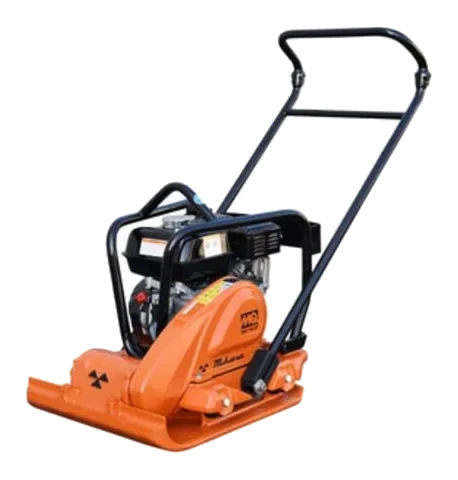
A forward plate compactor vibrates a steel base plate against the ground, shaking sand, gravel and crushed stone down into a dense, settled layer. Also known as a small plate compactor.
This is the smallest plate we rent and the one to reach for in trenches, along footpaths and in any space too tight to turn a bigger machine around. Three or four overlapping passes at full throttle is normal.
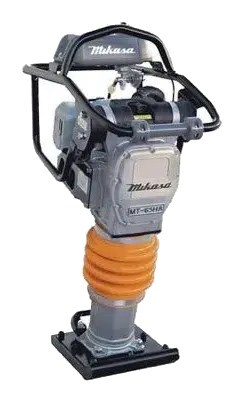
It only works on granular material. Wet, sticky clay will not compact under a plate however many passes you make — that job needs a jumping jack rammer, which pounds rather than vibrates.
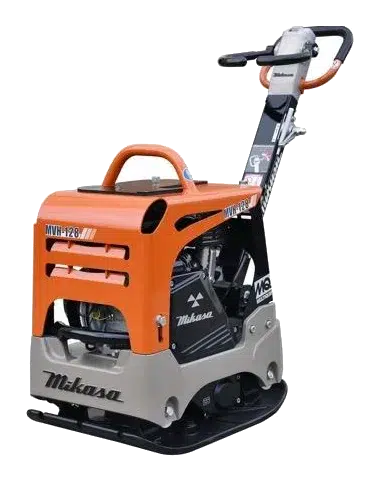
Ask what the material is and how big the area is. Granular and tight means this plate; granular and open means the large plate or a roller.
Catalogue specifications
MOD# MVC77H
CENTRIFUGAL FORCE LBS(KN) 3,350 (6.76)
EXCITER SPEED 5,800 VPM
SPEED MIN FT(M) 82 (25)
ENGINE HONDA
HP(KW) 5.5 (4.2)
PLATE SIZE WxL IN 17x22.4 (43x57)
WEIGHT LBS(KG) 163 (74)
MOD# MVC80VH
CENTRIFUGAL FORCE LBS(KGF) 3,080 (1,400)
EXCITER SPEED 5,600 VPM
HP(KW) 5.5 (4.0)
PLATE WIDTH IN(MM) 17.7 (450)
WEIGHT LBS(KG) 176 (80)
MOD# MVC82VH
SPEED MIN FT(M) 72 (22)
PLATE SIZE IN(MM) 17.7x22.4 (450x570)
WEIGHT LBS(KG) 181 (82)
What this will run
Typical figures for this class of machine. Check the data plate before promising a customer.
Best uses
Sand, gravel and crushed stone (granular material)
Paver, patio and walkway base preparation
Trenches, footpaths and confined areas
Small asphalt patch repairs
Not suited for
Wet, sticky clay — use a jumping jack rammer instead
Large open areas — a large plate or roller is faster
Troubleshooting
Engine runs but the plate won't vibrate
Likely causes
Throttle not at full
Worn or broken V-belt
Worn clutch
Checks to try, in order
Move the throttle to full. At idle the clutch disengages and the plate stops vibrating — that's normal.
Stop the engine and look behind the belt guard for a loose, broken or thrown V-belt.
Check the plate for caked mud that is damping the vibration.
Belt and clutch replacement is a workshop job.
Reference draft — always follow the manufacturer’s manual.
Turn the fuel valve ON and the engine switch to ON.
Cold engine: close the choke. Warm engine: leave the choke open.
Check there is fresh petrol in the tank — stale or water-contaminated fuel is the most common cause.
Check the engine oil. Many engines have a low-oil shutdown that stops them starting when oil is low or the machine is on a slope — top up and set the machine on level ground.
Make sure the spark plug cap is pushed fully onto the plug.
Pull the starter rope with a smooth, firm pull — don't let it snap back.
If the starter rope is locked or unusually hard to pull, stop — don't force it. Tag the unit and return it to the workshop.
Reference draft — always follow the manufacturer’s manual.
Always follow the manufacturer’s manual and site safety rules. Favourites and viewing history are stored on this device.
FRAUD ALERT
We are aware of an individual claiming to be the CEO of Hilton Machineries & Sales Company and falsely representing that they are purchasing equipment through Massive Equipment & Sales Ltd.
Massive Equipment has no affiliation with this company or individual. Do not send funds, deposits or financial information in connection with these communications.
To verify any request, contact us directly at 345-949-7990 or info@massivegroup.com.