A pressure washer pumps water through a narrow nozzle hard enough to strip dirt, grease, tar, gum, wax and rust staining off hard surfaces — the job a brush and soapy water would take all day to do badly.
We rent three: 1000 psi for light duty, 3000 psi for general work and 3500 psi for heavy duty. Driveways, patios and walkways, siding and decks, vehicles and equipment are the usual jobs.
Pressure is only half of it; the nozzle decides the rest. Red 0° is a pinpoint jet that cuts wood and paint and is best left in the box. Yellow 15°, green 25° and white 40° cover real work, and black draws soap.
Start with a wide tip about 2 ft back and move closer only if you need to. Never start or run the pump without the water supply connected and turned on.
Catalogue specifications · 3500 psi
What this will run
Typical figures for this class of machine. Check the data plate before promising a customer.
Best uses
Driveways, patios and walkways
Siding and decks
Vehicles and equipment
Grease, tar, gum, wax and rust stains
Not suited for
Close-range spraying of wood, car paint or window seals
Anything electrical
Attachments & kits
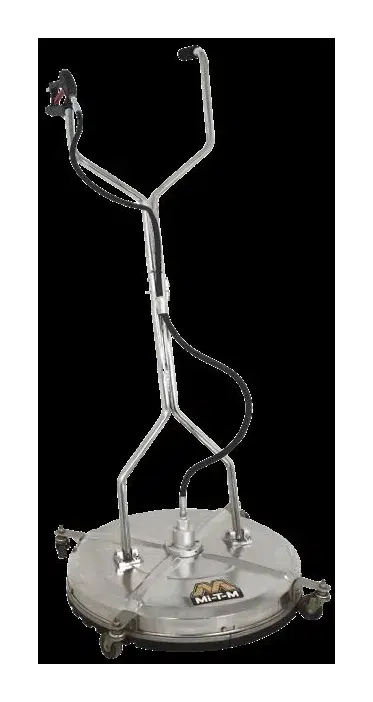
Rotary surface cleaner
Even, streak-free cleaning of driveways, sidewalks and decks
Ask the counter about availability and inclusion
Extension wand
Reaches taller buildings
Ask the counter about availability and inclusion
Nozzle tips
0°, 15°, 25°, 40° and soap
Ask the counter about availability and inclusion
Troubleshooting
Low or pulsing pressure
Likely causes
Poor water supply
Clogged inlet filter
Soap nozzle fitted
Air in the pump
Checks to try, in order
Turn the water tap fully on and check the supply hose isn't kinked.
Clean the inlet filter screen where the garden hose connects.
Swap out the black soap nozzle — it's low pressure by design.
Purge air: with the engine off, squeeze the trigger until a steady stream of water comes out, then start.
Reference draft — always follow the manufacturer’s manual.
Turn the fuel valve ON and the engine switch to ON.
Cold engine: close the choke. Warm engine: leave the choke open.
Check there is fresh petrol in the tank — stale or water-contaminated fuel is the most common cause.
Check the engine oil. Many engines have a low-oil shutdown that stops them starting when oil is low or the machine is on a slope — top up and set the machine on level ground.
Make sure the spark plug cap is pushed fully onto the plug.
Pull the starter rope with a smooth, firm pull — don't let it snap back.
If the starter rope is locked or unusually hard to pull, stop — don't force it. Tag the unit and return it to the workshop.
Reference draft — always follow the manufacturer’s manual.
Always follow the manufacturer’s manual and site safety rules. Favourites and viewing history are stored on this device.
FRAUD ALERT
We are aware of an individual claiming to be the CEO of Hilton Machineries & Sales Company and falsely representing that they are purchasing equipment through Massive Equipment & Sales Ltd.
Massive Equipment has no affiliation with this company or individual. Do not send funds, deposits or financial information in connection with these communications.
To verify any request, contact us directly at 345-949-7990 or info@massivegroup.com.