Knowledge Base ♡ Favourites Equipment / Pumps / Sump Pump 06 · Pumps
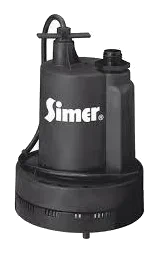
Sump Pump Also called Utility sump pump · Garden hose pump · Basement pump
A small submersible pump with a garden hose outlet, for clearing standing water from pits, sumps and flooded floors.
Electric (corded)
♡ Save Copy link Print spec sheet
Overview Best uses Troubleshooting (5) Safety Videos & links Overview A sump pump sits in the water and pushes it out through a garden hose. It is the simplest way to clear a pit, a sump or a flooded floor.
It handles clean to slightly dirty water, and most units will pump down to a shallow depth, which matters when clearing a floor.
Flow is modest and it will not pass solids of any size. Leaves, grit and debris block it.
For dirty water with solids, use the trash pump. For a deeper, larger volume, use the submersible pump.
Catalogue specifications Weight: 9 lb
Portable and versatile, can be used in a variety of areas; window wells, basements, rooftops, etc. Maximum pumping capacity to 2160 gallons per hour. Rugged thermoplastic body resists corrosion. Powerful 10 amp motor with automatic thermal overload protection. Includes 8' power cord and garden hose adapter. Pumps down to 5/8". What this will run Supply model Typical figures for this class of machine. Check the data plate before promising a customer.
Best uses Clearing sumps, pits and lift shafts Flooded floors and rooms Draining shallow standing water Not suited for Water with debris or solids Continuous duty — these are intermittent-use pumps Troubleshooting Find a symptom Does not start when it hits the water Checks to try, in order Check the float is free to rise — it switches the pump on. Check the supply with another tool and use an RCD-protected outlet. Reference draft — always follow the manufacturer’s manual.
Runs but moves no water Checks to try, in order Unplug it and clear the inlet screen. Leaves and grit block it quickly. Check the discharge hose for kinks. If the water has solids in it, this is the wrong pump — switch to a trash pump. Reference draft — always follow the manufacturer’s manual.
Tool won't switch onShared · Electric (corded) Likely causes Tripped GFCI or breaker Lock-off button Damaged cord Dead outlet Checks to try, in order Check the outlet works and reset any GFCI / RCD that has tripped. Release the lock-off button or safety switch before squeezing the trigger. Inspect the cord and extension lead for cuts, crushed sections or damaged plugs. If running from a generator, make sure it's running and its breaker hasn't tripped. A damaged cord or plug means the tool is out of service. Tag it and return it — never tape a cord.
Reference draft — always follow the manufacturer’s manual.
Keeps tripping the breakerShared · Electric (corded) Likely causes Circuit overloaded Undersized extension cord Blunt accessory Checks to try, in order Plug into a circuit with nothing else heavy running on it. Use a shorter, heavier extension cord. Long, thin cords starve the motor and trip breakers. Don't force the tool — a dull bit, blade or disc makes the motor draw more current. Reference draft — always follow the manufacturer’s manual.
Overheating, burning smell or heavy sparkingShared · Electric (corded) Checks to try, in order Stop and unplug the tool. Check the motor vents aren't blocked with dust. Let it cool, fit a sharp accessory and let the tool's weight do the work. Heavy sparking from the vents or a burning smell that returns points to worn brushes or a failing motor — workshop only.
Reference draft — always follow the manufacturer’s manual.
No fixes match this symptom.
Safety Unplug before handling the pump. Never reach into water with the pump live. Use an RCD-protected supply for any pump in standing water. For electric (corded) Inspect the cord and plug before every use. Use a GFCI/RCD outdoors or near water. Unplug before changing blades, bits, discs or pads. Wear eye protection, and a dust mask when cutting, grinding or sanding masonry. Always follow the manufacturer’s manual and site safety rules. Favourites and viewing history are stored on this device.
×